Showing posts with label 2017. Show all posts

Friday, December 15, 2017

WE HAVE GROWTH!

Our columns were set up to test the hypothesis that different sediment sources will produce different communities in a Winogradsky column. To test this, variables such as mud source, light, volumes, amount of carbon and sulfur sources, nitrogen, magnets and air permeability were tested against the controls of duck pond mud, construction dirt, and a mix of both, while using duck pond water as our H2O source. 

Viola, we have growth! The video shows that not only did we have visible bacterial growth, but we also grew some worms. These worms hated to be disturbed, any movement of the column resulted in the worms retracting further down. 

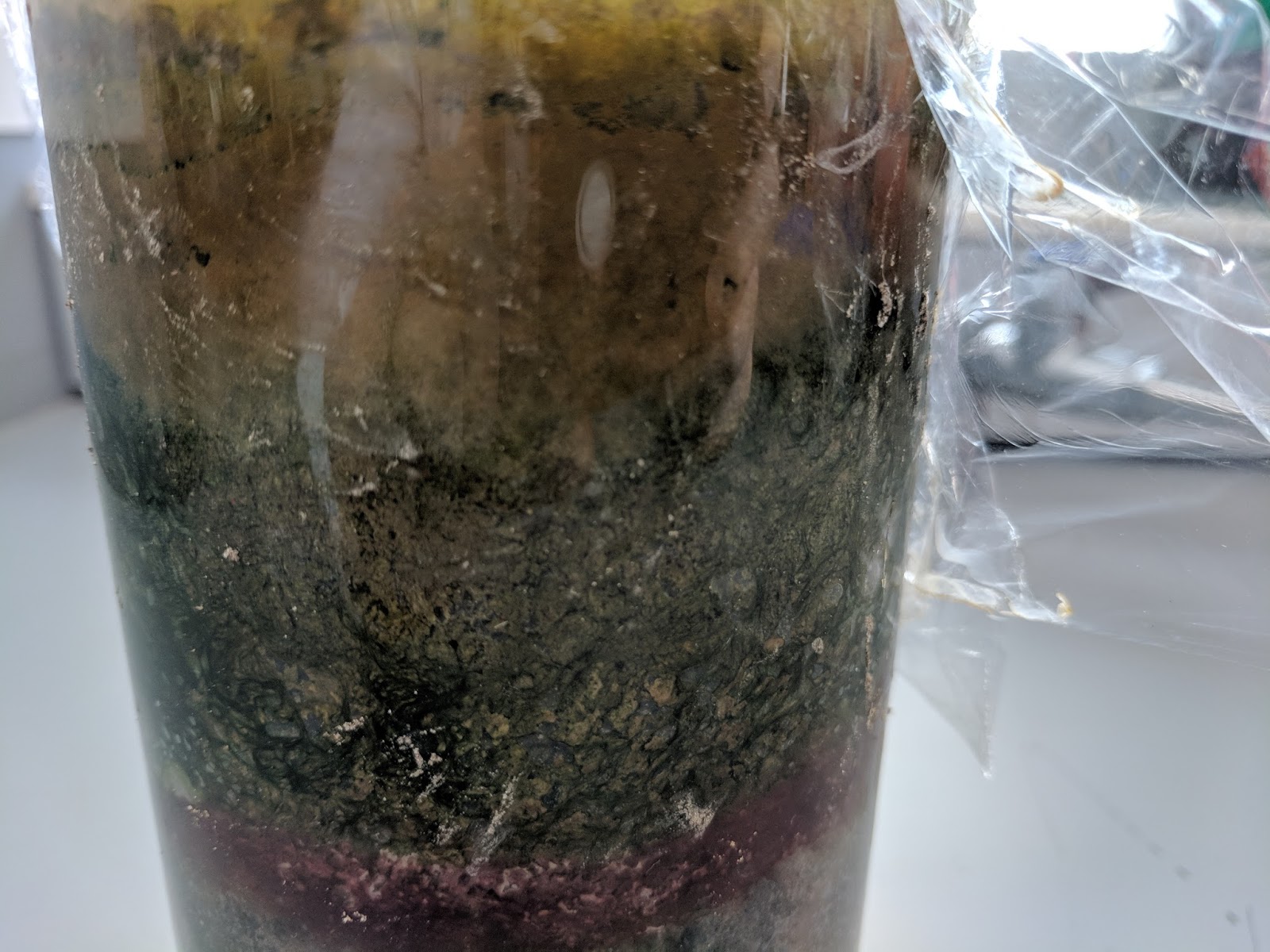
These columns turned out better than I expected. Several different communities could be observed as bands of color throughout the columns. Some exhibited bands of what appeared to be iron sulfur bacteria due to the thick red band. Dark bands of sulfur could be seen as well as green sulfur bacteria that photosynthesize the available sulfur in anaerobic environments. All of these colors have been influenced by the different variables present in the column, which in turn influenced the favorable growth conditions for the observed bacteria!


(VIDEO)
https://weber.instructure.com/courses/441947/discussion_topics/1941122
(VIDEO)
Ryan Clay

Saturday, December 9, 2017

Winogradsky Column Wrap up
Summary of the experiment:
               When the winogradsky column was started there was a control made with duck pond water and dirt and it was allowed to grow without changes. The column I looked at was started in the same way but it only contained egg shells and the hypothesis was that the column would not grow organisms or layers of material as well as the control column. This hypothesis was tested but setting up the control column first. The control had egg shells with the yoke and albumin of the egg as well. This provided a carbon source as well as a sulfur source to the column. The shell only column provided a carbon source without the sulfur source from the contents of the egg. After that the columns were similar because they were mixed with duck pond dirt as well as water and set in the window to grow. The expectations were that the control would be able to grow and have layers of organisms and colors and that the shell only column would not have as many layers of colors or as many organisms but boy was that wrong!
Pictures:
Day 1:


Last day (12/01/2017):

Analysis:
               The column that was the shell only turned out better than expected, not only were there colors and layers of materials within the column, there were tons of organisms. The first organism was cyanobacteria that were huge and waving around all over the column. They had created holes in the ground where they moved around and even popped out of the top of the dirt mixture. There was also a snail at the top of the column that appeared weeks after the column had been assembled. There were mainly green colors within the column and there were patches of darker green algae on the side where the light was coming in. There was a lack of purple layers and pink layers which may mean there were a lack of purple sulfur bacteria that may be one of the large differences between the other columns and the shell only column. So the most important influences on this column appears to be light, cyanobacteria are photosynthetic organisms and they were very present in the column. Sulfur bacteria did not seem to be present in the column so most of the layers that grew were green. It was such an interesting difference and it was great to see how one simple change can create and entirely different column and environment.

-Kristen Mayfield

Friday, December 8, 2017

The best darn cocktail you'll ever have


And finally, the reveal!


We have been coddling these little columns for long enough. (And by that we mean we’ve let them grow as they would without any assistance, thinking about them once every two weeks and denying them even the negligent care we would give a cactus houseplant. For heaven sake, one of them wasn’t even allowed light! It’s worse than Oliver Twist.)


From the beginning of this project, we set out to see if the growth patterns of Winogradsky communities would be different without the presence of light. It was our hypothesis that the growth between the lighted column and the darkness column would be different due to the nature of the environment being so selective against photosynthesizing microbes. We also expected that the darkness column would manifest different communities due to the relative increase in temperature caused by being enshrouded by an insulating plastic blanket. If you’ll remember, we made up two columns the same way, providing each with carbon and sulfur sources in the form of a raw egg. Our soil and water were taken from Weber State’s duck pond. One of the columns was wrapped (all but the top) with a black plastic bag. Both columns were stored in the same same window, so each was exposed to the same amount of UV. This blog has kept a running log of their progress, but we have not yet removed the mysterious plastic bag.


Until now. Here it is, the moment you’ve all been waiting for! This very day we took our final pictures of our columns and removed the garbage sack from the exterior of the darkness column. We’ll let six pictures be worth six thousand words.


Darkness Column:
Not very exciting, eh? Yeah, that’s what we thought too, shockingly anticlimactic. But let us be kind to our little column. This is just the type of result we would expect from a location where photosynthesis is not favored. Photosynthetic microbes are the ones with the pigments, and since the column in general was shielded from all light, no pigmented bands, such as in our other column, can be seen in the interior our darkness column.

We’ll now reward your patience with some pictures of our beautiful control.

We found it interesting that the tops of the columns look entirely different. The control, supplied with ample light, had a clear top, save some filamentous tendrils. The darkness column’s top was crowded over with photosynthesizers, and was the only place that any trace of pigments were found. These results are precisely what we would expect.

Have you ever wondered to yourself “Is the sulfur cycle delicious?” because our columns should answer that for you. I don’t know about you, but I think “yum!” when I see those. Oh, and if you ask google to search the photo of these beauts to find similar images it comes up with cocktails. I don’t know about you but I smell OPPORTUNITY, (or maybe that’s just the microbes…) the revolutionary mixed drink of 2017… The Winogradsky. Colorful. Pungent. Potentially [in]toxic[ating]. Bartenders everywhere will line up to learn how to grow this up. Anyway, back to the whole biogeochemical cycle ordeal. Obviously we have some wicked purple and green sulfur bacteria in that mix column that are just gorgeous, and they’re gorgeous because they’re phototrophic. But the darkness column would be chemoautotroph’s which would fixate carbon dioxide (so the carbon cycle) by oxidizing sulfur and iron. They both utilized the oxygen cycle since there’s a ton of good green stuff at the top of the mix column and even at the top of the seran wrap of the darkness column.

But, we’ll let these little guys keep doin’ their thing. Perhaps we’ll see pigments emerge now in the darkness column; we did not put the bag back on it. Only time will tell what shenanigans these columns will get into, left on their own, will all the students gone for a month. Surely that’s not ominous. We only hope that nothing grows feet or plans world domination. If it does...We’ll just blame Dr. Frantz and we take absolutely no credit for these “cocktails”. As you can imagine, we’re just really sad to say au revoir to these fun times of blogging (because all Utah girls aspire to be bloggers right?....Not.) But enjoy some before and afters of our beautiful cocktails below. Until next time, just kidding… There won’t be a next time.

Sincerely,
(The authors of these wicked good blog posts)...Emily and Serena, #letthegoodtimesroll👊

Before (the darkness column, under its disguise, looked the same as the control):After:

Saturday, November 11, 2017

Mirror Mirror on the Wall...

Who’s the fairest microbial mat of all?

Emily and Serena's Winogradsky column of course! Snow White ain't got nothin' on this goodness. Just look at those wicked layers. The sunlit side with the red and green obviously love the sun because they definitely aren’t growing on the east facing side toward the classroom. You’re not alone little microbes, we too rather be outside where the sun is shining... But alas, we professional students essentially have taken up residence in Tracy Hall... We presume the red layer is purple sulfur bacteria, the green layer above that being green non-sulfur bacteria and possibly the murky brown-orange(ish) color below the water is purple non-sulfur bacteria (disregard the fact that it is not remotely close to any shade of purple). The green stalks are still in there doing their thing—whatever that “thing” is.


The darkness column is still covered and doing swell we’re sure. Mostly because what we can see from the top looks gnarly—so we know whatever is deep in there has got to be pretty darn wicked. We can’t wait to uncover it the first part of December (and the last week of the semester before finals—woohoo!)

Over and Out.
-Emily and Serena

Friday, October 27, 2017

Houston, we have growth!

My, but these columns are actually starting to be interesting.
We have since stopped taking the covering off of the darkness column, so as not to skew the data. Nevertheless, there is still action happening in there. The saran wrap covering the column in bowing outward, suggesting that whatever is inside is producing gas. The plastic roof is colonized by marshy green films. It makes one wonder what will happen when they cover the wrap so completely that no more sunlight can reach the interior of the column…


The control looks like a little terrarium. Long, green, filamentous stalks are growing toward the roof of the column, and water is still condensing there. There is a distinct layer just beneath the surface that looks to be primarily water with some squishy freeloaders just hanging out in the moisture. On the sunlit side, there are two prominent bands of color, one red and the other green. The green band, just further up in the column is much wider than the red, three to four times wider. Seeping toward the base of the column in nonuniform points is a lighter brown layer. Though that may be merely a section of different soils, not mixed in well, we doubt it. These different sections certainly enjoy light but not so much the presence of oxygen. That at least is a comfort if ever someone lets these unearthly creatures free on the world.


Live long and prosper!
-Emily and Serena


Darkness Column


Mix Control

Monday, October 23, 2017

Streaky streak streak

No not the sort of streaking that first comes to a college student's mind. But this red streak thing in our dark mix control column... It's becoming larger. Whatever that means, we're not really sure yet but we are stoked to see it continue to streak. No, still no cool nematode things in our column sadly 😒 However, our covered mix column is still safely wrapped because as we said last time we're just trying to give it some space, you know? It's like a teenager, very fragile, doesn't like sunlight, hides in the basement--aka we imagine whatever is in there does not like UV light so we're just trying to baby it, don't judge.

Enjoy our streaking.
-Emily and Serena


Mix Control Column (10/13/2017)


Monday, October 16, 2017

Geo micro Winogradsky column:
So this column started with some eggs, Weber state duck pond water, Weber state duck pond mud to see what would happen if there was only a carbon source added to the initial slurry and no sulfur source from actual egg. Initial pictures are below and the mixture was dark mud with green and cloudy water.
Initial Column: Sept 16, 2017


There is not a lot going on initially the mixture was just made and there are few signs of life. In a perfect column, there would be a mixture of a carbon and sulfur source on the bottom (Eggs) and then that would be mixed with mud, sediment and then water on top.
After 1 week: Sept 25, 2017

A layer between the sediment and water began to mix and form a darker layer of material. It was difficult to see if there were any organisms hopefully soon something will change.


Week 2: Oct 2,2017
The column is becoming greener and there seems to be some expansion in the dirt mix. There are still no signs of major organisms but there are changes occurring in the column.


More updates to come!

~Kristen Mayfield

Monday, October 2, 2017

Winogradsky Column Blog Update (week of 10/2/17)

The Mix column has shown some interesting color changes. There is a red streak and with some touches of purple in the mixture. The worms found in the "egg shell only" column are growing more robust. They are longer and there seems to be more of them.


-Christian Curneal

Winogradsky Column Blog Update (Week of 9/20/17)


Winogradsky Column Blog Update (Week of 9/20/17)

The columns are looking great! The most interesting one is the “egg shell only” column. It has some sort of worms growing in it. They move all on their own by wiggling in the water at the top. The rest of the columns seem to look the same as the first week.


-Christian Curneal

Friday, September 29, 2017

Slowly pluggin’ and chuggin’ away.


Our columns are looking great! Definitely, something you want to dish up to the in-laws for Thanksgiving. The mix control has a red streak through the center, and condensing on the plastic wrap is one bright yellow bubble. The darkness column looks very similar, minus the red streak, and it has filamentous white patches that match the control. The darkness column also has what used to be a colored bubble on the saran wrap, but all that is left is the red coloration.
We certainly have not seen any of the crazy move-on-their own nematodes that have graced other columns, but we’re sure life is doing its thing like crazy in there anyway. We do have a concern that taking off the darkness column packaging might kill the organisms inside that are not fond of the UV so we may decide to hold off on taking further pictures of that one for a while.

And we outskies for today's blog post! Enjoy ↓
-Emily and Serena

Mix Control


Dark Mix


Tuesday, September 19, 2017


WSU Geomicro 2017, where geo and micro nerds come together for the common good.


Winogradsky Columns... What are we testing? The combination of dirt, carbon, sulfur, and water. Oh, and some unintentional duck feces and twigs and such, and maybe some parts of construction workers made it in there too. So again, what are we testing with all this goodness? What microbes are going to grow and how growth differs based on the variables. Exciting ay? We think so.


What are the variables? Well, a handful of things. It used to be more than a handful of things, but then in the middle of the experiment it became apparent a few of the variables were not logical. So, here we are, with only a handful of variables and the oh-so-typical and necessary “controls.”


Controls, Variables, and Procedure
Conditions of mud sample site:
Air temperature: 30.5 C, 20% humidity, sunny, light breeze
Water temperature: 27 C, calm
DPM temperature: 30.9 C, full of sticks and leaves and fowl excrement


DP Water Retrieval
We used a blue bucket to scoop up duck pond water and poured it into a three-gallon water container and returned it to the lab.


DPM Retrieval
We began on the north side of the pond, Serena overcame her germaphobia to scrape the mud from the bottom of the pond for its sediment only to discover the pond is actually concrete... Pretty big kink in the plan, right? But no worries, eventually we found this plot of mud surrounded by ducks and geese who started coming at us—assuming we had food. We did not. Once they realized this they quickly deserted. So, with kitchen spoons, we dug up this mud which smelled of foul avian feces. We collected the mud in a blue bucket and carefully carried it back to the lab.


Mix Sediment Control
Procedure: An egg was smashed into a column. Equal amounts of DPM and CD were added to the 30% line, and the soils and egg were mixed together in a slurry. More soil was added to the 80% line. Then water from the Weber State duck pond was added to the 90% line. The column was covered with saran wrap secured with a rubber band, and the column was placed in the west-facing window of Tracy Hall lab 462.


Mix Darkness
Procedure: The column was set up in the same way as the mix control. The column’s sides were then covered in a black garbage sack and taped and rubber banded in place. The top of the column was left open to the sunlight from the west-facing window of Tracy Hall lab 462.


The Column of Greatest Importance
Now that we have the basic rundown of this entire Winogradsky experiment, let’s narrow this down to which column we (Emily and Serena—the authors of this wicked good blog post) are going to be observing over the course of the semester.


We chose to observe and track the progress of growth on the “Mix Darkness” column, compared to its control “Mix Sediment.”


Week One:
1           2 3 4


These pictures were taken at about 1:00 pm, Thursday, September 14, 2017. The garbage sack around the dark column was carefully removed and pictures 1 (side facing the window) and 2 (side not facing the window) were taken. The control was merely turned to get shots of the sunlit side (4) and the side that does not face the window (3).

We hypothesize that the garbage sack will affect growth due to the lack of sunlight as well as the insulation. The bag will make the column temperature slightly warmer as well as dark. The diversity of growth, we believe, will consist of microbes that hate UV light and microbes which are facultative when it comes to UV light, resulting in a greater visible diversity than the control, which is exposed to light all the way around the column.

That's all for this week, folks! Stay tuned!
--Serena and Emily

Oscillatoria princeps dating profile- extra credit

                 Oscillatoria princeps     131                    📍  10 miles away