Showing posts with label weekly observations. Show all posts

Friday, December 7, 2018

Blast From the Past of September 28th
by Connor Harding
Hey Everyone, its been a while and I thought I posted this a long time ago.
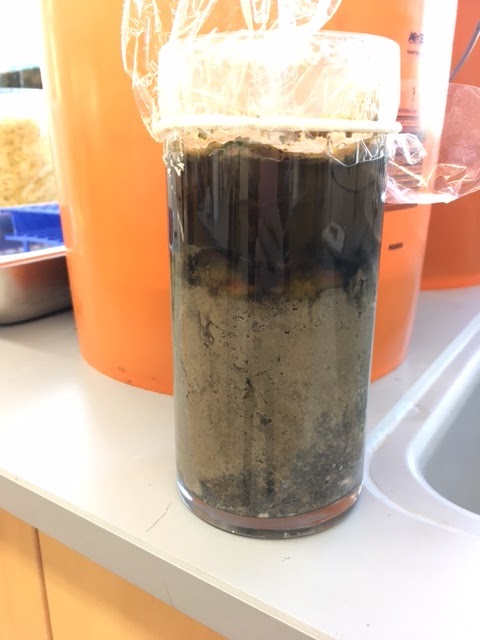
 As you can tell, we have a little bit going on here in the 4% saline column, only a 0.3cm black band. The water is slightly green which is a good indicator of cyanobacteria growth.

 The 12% saline solution had no growth at this juncture, there were no observable bands of colorings.
 Our control, which had no added saline, is growing fantastically, he has two bands, a 0.4cm wide black band that is 2.6cm below the water line. It has a nice thick green band of growth, of 2.2cm wide. His water has turned very green, with an abundance of algae or cyanobacteria growth.
The 8% solution has little growth, a single black band about 0.4 cm wide and it is 0.2cm below the surface line. The water is slightly green, which may be due to an algae or cyanobacteria presence.

The black line that we are seeing is likely a heterotrophic bacteria, due to its close growth with the green oxygen producers. Also because the control had a lot of green growth, the black band was thicker, so there is likely a correlation there, that more food meant more cellular division.

Friday, November 30, 2018

Flash Back on Cyano Progress on 10/26/2018


A little late posting my observation notes from October 26th but better late than never. Our hypothesis for this experiment was we would see less stratification as a result of increasing salt concentrations. That hypothesis still rings true with what I observed.

As pictured in Image A, the top couple centimeters of the top are strictly water, until of course you reach the sediment build up that characterizes the rest of the column. The amount of growth in these top water column areas is very telling. The color of the water in the 12% salinity column is lighter than the 8% and considerably clearer than the 4% which was brown. The control top water column was bright green indicating strong cyanobacteria growth. The clearer water in 12% and 8% indicate little to no growth in these sections despite proper light, water and nutrient exposure. Thus, supporting our hypothesis that we will see fewer organisms in higher salt concentration columns.

Additionally, I observed that the control column had the most stratification (based on color or obvious lines) with five distinct layers. On the other hand, 4% salinity had four stratification layers; 8% and 12% had three layers (Image B, C and D) . This also support the hypothesis that the higher the salt concentration the fewer the organisms capable of growing in that environment.

Other observations to note- In the control, the side facing the window had very bright green cyano growth through most of the column (Image E). The other three columns didn't show significant differences between the side of the column facing light and the one not facing the light. The first stratification layers (counting from top to bottom) for all four columns started at or above 9 cm from the bottom. More specifically, the first stratification layer for the control and 4% salinity were both right around 9 cm. The first stratification for 8% and 12% were both at 11.5 cm.

To conclude, our columns so far are supporting our hypothesis and showing small increased amounts of growth each week.

Maya

Image A. All four columns from left to right- control, 4%, 8%, and 12% salinity. Top stratification layer shows distinct differences in color with 12% showing the lightest water column. This indicates the smallest amount of growth. 

Image B. 4% salinity column showing 4 stratification layers. The side pictured faces away from the window/light. 


Image C. 8% salinity column showing 3 layers of stratification. The side pictured faces away from the window/light. 


Image D. 12% salinity column showing three layers of stratification and a light top layer of water. The side pictured faces away from the window/light. 

Image E. Picture of the light facing half of the control column showing strong cyanobacteria growth. 


How are our Winograddsky columns doing?

GeoMicro 3753Fall 2018 Winogradsky Columns

        Well, It has been 12 weeks or so since the creation of our mad experiment. We took a bit o' duck pond water, some soil stolen, umm, acquired from nearby and added a dash of sodium chlorite (that's salt; just sayin') in varying concentrations...threw in an egg to grow on... and we were off! Once in a while over the term, somebody would check in on our growing microbial high rises, take some candid photos and give us all on ongoing status update here at the Weber Geo Micro blog.
         As a budding Geologist, I must admit that growing microbes in soil wasn't of much interest; however, the results are quite amazing. You notice above, we have several columns. Each column represents a percentage of sodium (there's that salt again!). Can you guess which one has no salt added to our "fresh' water and soil? (Hint: it's the one on the left with no percentage marked on it.) I am really impressed with the stratifying colors. The layers are different types of microbes, bacteria, living at on the different 'floors" of the microbe high rise. This shows how different needs can be served for different species of bacteria: ya know, like the access to oxygen, the egg nutrients (carbon and sulfur), how much sunlight they get etc. 

Here's a look at the tops of the columns, the penthouse suite of the high rise! Do you see all that nice frothy growth? It seems as though the high salt content of our 12% column isn't as much of a party as the totally fresh column. Back to the stratification (layering);


 Wow! The control column; that means no salt added, is really growing some layers! This a view of the room side; away from the direct sunlight. We have some nice greens, black and even a bit of yellow and white. I wonder what the sunlight side looks like?


Wow again! With the direct sunlight, the layers are very thick and penetrate the soil almost to the bottom. Down there near the egg at the bottom will be the yummy sulfur that some of the bacteria like to eat. Some times ground floor of the high rise is a party too! Let's take a look at the poor 12% saline column, shall we?


Hmm, not as exciting at all. This is the sunlight side and you can tell right away that there just isn't as much going on. The layers are very thin, except that top grey brown milky looking stuff. There is a nice black layer but once again, very thin and not penetrating the soil. It would seem that microbial community that lives in the duck pond is not to fond of salt. But also interesting is that something is growing and surviving...on little oxygen and far away from the yummy egg in the soil. even in adverse conditions, the microbial world finds a way to live. Of course, the real party is going on in the control column.

Looking back at the top photo, you can see that a rich community grows in each column until you get to the 12% saline. Granted; the diversity and richness declines at each level (4% and 8% if you were wondering). It would seem that the original question of "does the saline concentration have an effect upon the growth of bacteria in fresh water from the pond?" is answered with a resounding YES!

My scope of interpretation on what each of the layers means in term of what bacteria are growing is limited and the attention span is slim. I can reveal to you that each layer, as mentioned above, represents a particular microbe with particular needs. Some seek the sun and available oxygen, others seek the dark depths of the soil, looking for the sulfur and carbon of the egg. Some of the microbes follow the others, feeding off of the by-products of their neighbors and in their turn feeding yet other microbes. I leave the technical aspects of this experiment to my microbiologist colleagues. I am confident that in the future as I learn more about how the smallest things (microbes) affect our planet, I will remember this experiment. So I leave you, dear reader with this...Life is rich and persistent but even small changes to the conditions of that life can have profound effects. As demonstrated by the higher saline content, even adverse conditions will yield some results.

Steve Moore
Applied Environmental Geoscience
Geosciences Department


Sunday, November 25, 2018

Winogradsky Column Update 11/9

The columns are beginning to show some separation in the stratification levels. The biggest changes being in our control column. This control had no salinity added to it,which begs the question, can the salt have that much of an impact on an ecosystem? In the control we have growth on top of the water, in the water, and under the water. This is classic stratification as seen in the wild. If I were Steve Irwin, I would definitely proclaim this sample, "She's a Beaut!"

We then start to move up the salinity scale and things start to change. In the 4% salinity column, stratification begins to disappear... There is no longer the green top growth and the water changes to a mucky brown color. This could show that the addition of salinity, changes the growth patterns and the wavelength of light used for organisms to grow. At 8%, the water begins to clear and a firm black/brown color begins to develop between the aquatic layer and the sediment. This growth still uses light but not much it seems... We finally arrive at the 12% salinity, we still have that dark brown/ black color of organisms under the aquatic layer but its minimal. It seems we have extremely limited the growth nutrients but as always... Life finds a way.

-Thomas

P.S. Check out the observation as seen through my eyes below!

Figure 1.1 - Control Column (No Salinity)
Figure 1.2 - 4% Salinity Column 
Figure 1.3 - 8% Salinity Column
Figure 1.4 - 12% Salinity Column
Figure 1.5 - The whole gang with their favorite view

Week 9 - November 16th

November 16th observations
Josie Wood

From my observations I found that there was more diversity in stratification in the control and 4% salinity columns. From this, it is clear that an increase in salinity can affect what organisms are able to grow. I also found that that there was more stratified layers and colors on the side of the column that is facing the window at all times (see table 1).
For the control column the bottom layer appears to just be sediment, but the thickness of this layer differs depending on if it was on the light or dark side (6.5 cm vs. 9.1 cm respectively). The dark red-brown band is most likely anaerobic bacteria, however on the light side this band is thicker and specked with light green, possibly anoxygenic photosynthetic bacteria. Darker green bands on both dark and light sides are most likely communities of cyanobacteria and nonsulfur bacteria. The green water most likely contains both diatoms and cyanobacteria.
The 4% salinity column contains less stratification than seen in the control column. Again, the sediment is occupying the bottom 9.2-9.7 cm of the column. The dark side of the column then has a 1.2 cm band of dark green, most likely cyanobacteria, and then the water. The light side has a yellow band with pink spots between the sediment and the green band of cyanobacteria. This yellow/pink band may contain purple and nonsulfur photosynthetic bacteria.  
Both the 8% and 12% salinity columns had less stratification and did not show any changes between the dark and light sides. For both these columns the sediment occupies most of the space with a thin layer of dark green/black at the top of the sediment and then the water. These observations are similar to those that were made on week 8 although the green/black layer seems to be slowly gaining thickness. Approximately .2 cm to .7 cm in 8% salinity and from less than .1 cm to approximately .1 cm in the 12% salinity column.  


Figure 1. Control (left = dark side, right = light side)

Figure 2. 4% salinity (left = dark side, right = light side)

Figure 3. 8% salinity

Figure 4. 12% salinity


Figure 5. Top view (control on left with increasing salinity to the right)


Table 1. Recorded observations and band widths taken on Nov 16th. Columns with 8% and 12% salinity did not exhibit any differences between the light and dark sides.

Friday, November 2, 2018

Week 8 -- 02 Nov 2018

Week 8 Growth


The presence of five stratification layers are evident in the sediment of the control flask.  The bottom ~9.5cm appears to be just sediment, with no distinguishing characteristics, and likely has not developed into a stable community as of yet.  A thin, dark brownish-red band has appeared directly above that layer, occupying 1-2mm in places.  This layer is likely anaerobic and protected from the bulk of UV radiation.  Given its position, it is likely composed of sulfur bacteria.  A thick green layer sits atop that, occupying 2-2.4cm.  This community is likely composed of nonsulfur and cyanobacteria.  A thin darker green layer atop that, ~4mm, is likely a community of cyanobacteria, and the remainder of the column is occupied by 3cm of green water, likely containing diatoms and cyanobacteria.

Stratification in the 4% flask is less clearly distinguishable, though at approximately 10cm from the bottom an obvious dark green color change is apparent.  This developing community is likely within the photic and oxygenic range, and likely contains cyanobacteria and diatoms.

In the 8% flask, the majority of the sediment appears unremarkable.  A thin layer (~2mm) separates the sediment from the water layer above.  This layer appears dark, blackish green, likely containing any organisms capable of thriving in the saline environment.  A similar layer can possibly be observed at the top of the sediment in the 12% flask, though that corresponding layer is less than 1mm thick.  Turbidity in the water of the 12% flask is also notably lower than in the other flasks.
Figure 1 - Front view.  Left to Right: Control, 4%, 8%, 12%

Figure 2 - Top View.  Left to Right: Control, 4%, 8%, 12%

Figure 3 - Control

Figure 4 - 4% Salinity

Figure 5 8% Salinity

Figure 6 - 12% Salinity

Table 1 - Summary of Stratification in columns.
Darian Out.

Monday, October 15, 2018

Week 5 (Oct 12, a little bit behind the curve.)

Week five comes in late at week 6, (apologies to all for the timeline anomaly!)
The columns are definitely growing...stuff (ewww....too cool!) It appears that the control is in the lead for stratification, but then I'm a geologist in the making, what would I know about stratifying layers of microbial growth? To restate that, it appears that the control column has the greatest growth of green micro organisms. The layers may be obscured by the prolific growth. A better visual of the layering or stratification can be seen in the 4% saline column; much less growth of the brightly colored, happy looking bacteria though.  As stated, this post is behind the times so may be redundant with another post, (apologies again.)

The columns (10/12/15)

Control, window side

4% saline, window side

8% saline, window side (sensing a pattern here?)

12% saline, again from the window side.

Top view of our protein shakes...ewww, just kidding.


Salinity
Stratification
Height
Control
water
4.2cm
Sediment
12.2cm
4%
water
3.8cm
Sediment
10.3cm
8%
water
3.8cm
Sediment
10.8cm
12%
water
3.4cm
Sediment
11.6cm


Sunday, October 14, 2018

Week of October 8th

This week, the most notable change to the Winogradsky columns was the dramatic growth of the cyanobacteria in the 0% salinity column. The other columns have had little change, but the 4% column is beginning to show clearer signs of stratification. Because the first column has had such dramatic growth of cyanobacteria, it might actually obscure other layers, preventing us from counting them in the future. Hopefully other layers will grow enough to be clearly visible.
Figure 1. 0% salinity column with a large amount of growth.

Figure 2. 4% salinity column with some stratification.

Figure 3. 8% salinity column

Figure 4. 12% salinity column

Figure 5. All columns from 0% (left) to 12% (right). The column on the left has cyanobacteria growing even on the plastic wrap. Condensation obscures the view, but there is some floating matter on the other columns.

Salinity
Stratification Layers
Height
Control
Water
3.5 cm
Sediment Mixture
11.6 cm
4%
Water
3.1 cm
Sediment Mixture
11.0 cm
8%
Water
3.3 cm
Sediment Mixture
11.7 cm
12%
Water
3.1 cm
Sediment Mixture
11.9 cm

Monday, October 1, 2018

September 21 Columns

Week 2 Growth - 21 September 2018


Very little has changed since last week. Additional condensation has been noticed (see figure 6). No additional stratification layers have been observed.


Figure 1: Control
Figure 2: Salinity 4%
Figure 3: Salinity 8%
Figure 4: Salinity 12%

Figure 5: Front View
Figure 6: Top View

Salinity
Stratification Layers
Height
Control
Water
3.5 cm
Sediment Mixture
11.6 cm
4%
Water
3.1 cm
Sediment Mixture
11.0 cm
8%
Water
3.3 cm
Sediment Mixture
11.7 cm
12%
Water
3.1 cm
Sediment Mixture
11.9 cm


Oscillatoria princeps dating profile- extra credit

                 Oscillatoria princeps     131                    📍  10 miles away